
Ohioze Family of Okeigho, Iuleha
Demographically, Iuleha is easily the largest ethnic group in Owan West Local Government in Edo State. The name “Iuleha” is derived from an Edoid language which translates to “cooking tripod”. Iuleha is geographically shaped like an oval and it is situated in the western end of Edo State on the boundary with Ondo State.
Collectively, Eruere, Aoma, and Okpuje – the youngest of the lot – comprise Iuleha and each is a leg in the tripod. Each tripodal leg historically represents a child of the founder of Iuleha. Okpuje, like Aoma, is both the name of the land and the variant of the Efenmai language that Okpuje people speak.
The constituent villages in Okpuje are Okeigho, Ikpeyan, Oromen, Avbioghola, Ivbiodohen, Oah, and Iloje.
Ivbieleke is made up of Okeigho, Ikpeyan, and Oromen. Okeigho is the senior, followed by Ikpeyan and Oromen. Although Avbioghola is geographically located on Ivbieleke lands within Okpuje, it is genealogically and historically not part of Ivbieleke. Avbioghola used to be located beside Oah in the northern part of Iuleha. Its continued co-location with Oah became untenable due to a war. As a result, the people of Ivbieleke offered to accommodate Avbioghola people by granting them a piece of land to the north of Okeigho, next to Ivbiodohen.
Okeigho consists of three quarters in this order of seniority: Osiokpoloka, Okeigho-vboke, and Egure.
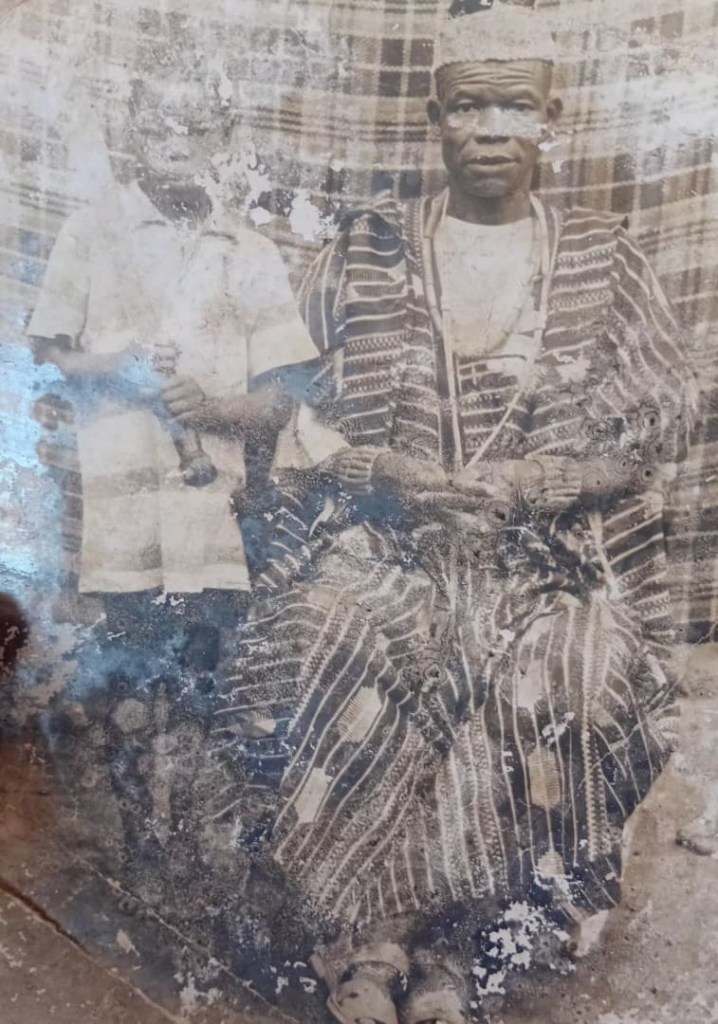
The Genealogy of Osiokpoloka
In the early 2000s, Chief Samuel Otokhile Ohioze gave a concise genealogy of Osiokpoloka to his son, Idowu Andrew Ohioze.
This narrative codifies Chief Samuel Ohioze’s oral history with additional facts and verification by other surviving Ivbi Ohioze, including the three oldest living octogenarians: Ikpengben Rowland, Ole-Ejere Felix and Iriaghomon David.
The name, Osiokpoloka, is derived from the name Okpoloka. Okpoloka was the father of Aichemeagan, making Okpoloka the progenitor of Ivbi Osiokpoloka.
Aichemeagan begot only one son: Oikelome.
Oikelome had no known male siblings, making him an only son of his father. Oikelome birthed two sons – Idu and Ohiwere. Idu was the first son of Oikelome. It is said that Oikelome would, whenever he went to his farm, place his son, Idu, in the custody of a widow in Okeigho-vboke. Presumably, Idu’s mother had died after giving birth to him.
Later, the widow – who had been previously married to a man in Ukhuse – who was said to be fairly advanced in age, became pregnant for Oikelome. The boy born by the widow to Oikelome was christened Ohiwere, by which Oikelome proclaimed, “Ohiwere me” (God has done this for me). Ohiwere was Idu’s younger half-brother.
Oikelome and his descendants entirely populate present day Osiokpoloka. This is why all ivbi Osiokpoloka are also commonly referred to as Ivbi Oikelome.
Idu had three sons who, in the order of seniority, were: Ababa, Idode and Ohioze. Idu also had daughters, in addition to his three sons. The names of some of Idu’s daughters are known to some surviving Ivbi Ohioze. Their names have been left out of this genealogy because our genealogy is patrilineal.
On his part, Ohiwere gave birth to four sons: Ojeikere, Asekhaen, Ogedengbe, and Imongan.
Much of this write-up focuses on Ohioze Idu for good reasons. One, among Idu’s children, Ohioze was the most procreatively productive. Fifteen of his children survived infancy. Two, all Ohioze’s children who survived infancy grew to adulthood and had children of their own. This is remarkable considering that Ohioze began growing his family in the 19th to early 20th century when present day advancement in medicine was non-existent.
We, Ivbi Ohioze, are the descendants of that great son of Idu, Ohioze. Beginning with Ohioze’s direct children, every male member of Ivbi Ohioze bears “Ohioze” as his surname. No son of Ohioze hyphenates his surname by adding that of his birth father. There is no ovbio Ohioze who bears “Idu” or “Oikelome”. This has created a uniform identity for Ivbi Ohioze.
Ohioze Idu’s mother was Iwagan, an Ivbi-Uhuru woman, which explains why Ohioze spoke Aoma and not Okpuje. Ohioze was a member of the Aisabe-ekpen age group (otu).
Samson Iriase (whom Ohioze called “Uanikhugba” and became Ohioze’s letter writer and reader while in primary four) describes Ohioze as a tall and light complexioned man.
Ohioze’s fifteen children were birthed by his four wives: Amina, Ohivokan (also known as Odigba), Oenghemen, and Itebimien.
Amina was from Ivbiodohen and she was Ohioze’s first wife. Amina gave birth to Ohioze’s eldest three children and had five in total. She had one son and four daughters namely Oein, Oenghian (female), Ukpodogua (female), Aidelomon (female), and Azegbefume (female).
The second wife, Ohivokan, was from the Akalakini family in Uzebba. Ohivokan had more children for Ohioze than his other wives. Ohivokan had eight surviving children for Ohioze: four sons and four daughters: Josiah Iboi, Ayeghegbe (female), Jimmy Oende, Atogho (female), Izaghabu, Samuel Otokhile, Omoyake Awanekenuan (female), and Ailekhuaye Elizabeth (female) who was Ohioze’s youngest daughter.
Oenghemen was from Izoghoi in Ikpeyan. She died shortly after giving birth to her only child, Joel Eimin, who was Ohioze’s third son and fifth child in the order of seniority.
Joel Eimin did not know his mother, having been raised by his maternal grandmother who miraculously began lactating following the death of Oenghemen. Joel Eimin was breastfed by his maternal grandmother who nursed him from postnatal to infancy. Joel Eimin would later follow in his father’s footstep to be installed as a chief and Odionwere of Okeigho.
Joel Eimin was the first direct son of Ohioze to, in 1961, become a chief and to assume the headship of Okeigho. Alas, the child whose mother died soon after his birth lived long enough to govern his people!
Itebimien was Ohioze’s last wife. A daughter of Chief Eguaoje of Oah, Itebimien married Ohioze when he approached her father seeking to obtain the prestigious chieftaincy title from him. Eguaoje, reportedly wary of further strengthening Ohioze’s burgeoning influence in Okpuje, offered, instead, the lowest rung of his chieftaincy title to Ohioze, effectively placing Ohioze below many other chiefs in Okpuje. Undeterred, Ohioze accepted the offer and as an incentive, married Eguaoje’s daughter, Itebimien.
When Itebimien gave birth to her only child for Ohioze, he named him Ole-Ejere by which he exultantly exclaimed, “omo le-ejere (this child is greater than chieftaincy title)”. Ole-Ejere Felix, now an octogenarian, is Ohioze’s last child and is currently the next in line to the headship of Ivbi Ohioze.
Ohioze became the oldest living male in Okeigho and Oromen in 1947 at which time he assumed the mantle of leadership as the Odionwere of Okeigho and Oromen, a title that is traditionally reserved for the oldest surviving male. Iuleha practises gerontocracy as a system of government.
Ohioze reigned as the head of Okeigho and Oromen from 1947 to 1967, a period of twenty years. He was the last person to rule Okeigho and Oromen as a combined entity, and his reign is still the longest in the history of Okeigho and Oromen.
It was during Ohioze’s headship that the infamous split, between Okeigho and Oromen, of the traditional ukpe Ofure festival occurred. The incident – which resulted from the nocturnal stealing of the Ofure regalia and paraphernalia from Ohioze’s residence by an Ivbiodohen man (known as Sunday Roman) who had been secretly contracted by Oromen elders – dented the relationship between the two previously closely aligned quarters which led to the separation of the celebrations of cultural activities till present day.
A remarkable event often associated with Ohioze is that he was reputed to have served Ofure twice. He was first appointed to take charge when his elder brother, Ababa, became the Odionwere but was visually impaired. Because of this condition, the family appointed Ohioze, his younger brother, to act on his behalf and oversee the affairs of Ofure. In this role, Ohioze functioned much like Iriaghomon David did for John Odion until his demise.
What made the situation remarkable was that Ohioze remained in control of Ofure (though officially in the name of Ababa) for such a long period that, by the time the mantle of leadership eventually fell on Ohioze as the Odionwere, many people believed he had served as head of Ofure twice.
On both occasions, his leadership periods were impactful. Each lasted so long that they became the longest in the history of those who had ever deputized for an Odionwere, as well as among Odionweres who ruled without stand-ins.
Ohioze’s reign as the Odionwere witnessed many epochal developments in Okeigho and Oromen. The most prominently celebrated are the establishment of the first church and a primary school in Okeigho.
- The Establishment of the Baptist Church
A branch of the Anglican Church was the first church to be established in Ivbieleke. That church could not thrive and was later relocated to Ikpeyan where it remains till this day.
Subsequently, one Pastor Abolagba from Eruere obtained Ohioze’s authorization to facilitate the establishment, by the Baptist Communion in Benin City, of a branch of the Baptist Church in Okeigho. The Baptist Church was founded in 1958 in Okeigho. Faced with space constraints, owing to the limited availability of housing at the old site, Ohioze offered his living room to the pastor.
Consequently, the Baptist Church in Okeigho and Oromen was begun in Ohioze’s house in 1958. The Baptist Church in Okeigho was the first in Iuleha. For a long time, there were just two Baptist Churches in Owan West Local Government: the one in Okeigho and another in Sabo.
The Baptist Church currently sits on the western boundary between Okeigho and Oromen.
While successive heads and adherents of ukpe Ofure have opposed the spread of Christianity in Okeigho and Oromen (as a way of preserving the supposed pre-eminence of this traditional form of worship), Ohioze – though unlettered – wholeheartedly embraced the advent of Christianity to Okeigho and Oromen.
As a testament to Ohioze’s commitment to Christian worship, he would regularly attend Sunday services even after presiding over activities in ugbo-ukpe (the shrine for Ofure). It is noteworthy that five of his seven male children bore biblical names at a time Christianity was nascent in Iuleha: Josiah Iboi, Joel Eimin, Jimmy Oende, Samuel Otokhile, and Ole-Ejere Felix.
Today, there are Ivbi Ohioze who are pastors. Most are practising Christians while one great granddaughter (Edeileokun Barakat) is a convert to Islam, having married a Moslem man from Auchi. A great grandson (Daniel Ivaivunu) is married to a Muslim, Lateefat.
We welcome all shades of faith in so far God is at the centre of the worship. When we wake each day, we call on Osebua, our creator.
- The Creation of Oleke Primary School in Ivbieleke
Oleke Primary School began in Ohioze’s living room in 1955 at the old site in Oalikpe. Children would gather in his living room while he sat by the side watching them being taught numerals and alphabets. The piece of land on which Oleke Primary School presently sits in Okeigho is Ohioze’s land which he donated to enable the founding of the school when the people relocated to the present site in the 1950s.
- Relocation to New Site
It was also during Ohioze’s headship that Ivbieleke relocated to its present site from Oalikpe. This monumental effort was championed by Ohioze’s son, Samuel Otokhile, along with two other prominent sons of Ivbieleke.
Notable Achievements by Ivbi Ohioze
One of Ohioze’s children, Samuel Otokhile, was the first to study up to the olden day’s standard five in Uzebba where he had gone to reside with a member of his maternal family, H.H. Eseche, who was a teacher. Lack of funds truncated Samuel Otokhile’s educational pursuits when he could not enrol for the standard six class and was forced to drop out of school.
Samuel Otokhile would later become the first Ohioze child to settle down in Lagos having left his older brothers in Ijebu Ode. Samuel Otokhile eventually singlehandedly opened the floodgate of Ivbi Ohioze in Lagos. He took the following Ivbi Ohioze to Lagos: Ailekhuaye, Joshua Azama, John Odion, Sunday Oarhe, Alice, Yetunde, Ayodele Robert, Jim Eniafe, and Ole-Ejere Felix.
Ohioze’s eleventh grandchild – John Odion – was the first Okeigho person to travel outside Nigeria when, in 1980, he spent six months in Boston, Massachusetts, USA on a training mission by the Nigerian Government. He was at the time a staff of the Federal Office of Statistics. John Odion was the first ovbio Ohioze to challenge the London certificate in education which is the equivalent of modern day GCE.
John Odion was also the first Ohioze grandchild to assume the traditional headship of Okeigho, joining the exalted class of Ohioze himself, Joel Eimin and Samuel Otokhile.
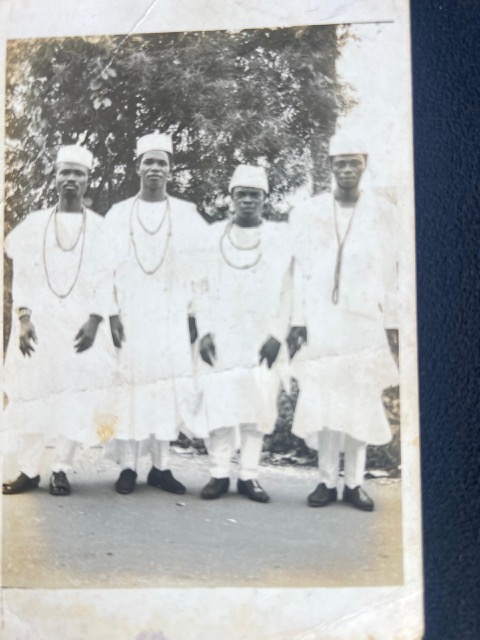
Ohioze’s descendants have excelled in various fields of study, both nationally and globally. Ikpengben Rowland, Ohioze’s grandson and current head of Ivbi Ohioze, was the first Okeigho child to obtain a post-secondary certificate. He gained admission into the Iwo Baptist Teacher Training College in 1963/64. He retired as a senior headmaster in Sabongida-Ora, having taught at many schools in Owan West Local Government, including Oleke Primary School, his alma mater.
A grandson of Ohioze, Samson Iriase, was the first child to be born in the entire Ivbieleke new site over seventy years ago.
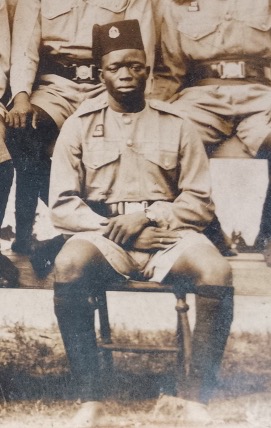
Another grandson of Ohioze – Iriaghomon David – is a hunter of great renown who is celebrated for his gaming skills and knowledge. A tree, known as Uziah, has been planted in the Ohioze family compound in Okeigho to commemorate Iriaghomon David’s heroic hunting of an eor (African buffalo). Only hunters who have successfully hunted a fierce wild animal can have an Uziah planted in their honour. He is the only hunter in Ivbieleke to have an Uziah planted in his honour. He is a retired soldier and currently serves as the president of the hunters’ association of Nigeria in Owan West Local Government.
In 1967/68, a three-member music band waxed the first music record in Iuleha. The band members were Jim Eniafe, Oba Imongan, and MCO Udo. Jim Eniafe was a grandson of Ohioze. Jim Eniafe subsequently created the Iuleha Dance Band in 1980. Members of that band were Jim Eniafe, Sunday Omoaregba, Ayo Robert, Iriaghomon David, Imoeko, Aigbokhaevbo Aienlevboise, and Ebunoluwa. Ayo Robert was Jim Eniafe’s older brother while Iriaghomon David, Imoeko, Aigbokhaevbo, and Ebunoluwa are grandchildren and great grandchildren of Ohioze.
Ivbi Ohioze are excelling in their educational pursuits. In 1985, the Ohioze family produced its first university graduate in the person of Oluwole Okhuoya who graduated from the University of Ibadan. Babatunde Okheoah followed in 1993, while Iriase Oaikhena and Gideon also graduated in quick succession in 1994.
Ohioze has descendants who have studied in globally recognized European and North American universities.
The Ohioze family has thus far produced two lawyers (Idowu Andrew and Josephine Omotiefe). Another descendant (Matthew Ohiochoya) has obtained a law degree in the United Kingdom and shall soon commence practise. An Ohioze great grandson (Michael Okheoah) is an Olympian who competed for the United Kingdom at the Summer Olympics held in Tokyo, Japan in 2021.
Several Ohioze grandchildren and great grandchildren have master’s degrees. Some are currently studying towards other postgraduate degrees.
There are degree holders in marketing, economics, agriculture, geography, Mass Communication, primary education, the sciences, business administration, etc. Among us are two high school teachers, a cocoa trader, a school administrator, a university lecturer, an accountant who was a former bank manager, a statistician, an electrician, a glass and aluminum technician, two members of the Nigerian Army, several police officers, business owners, managers, healthcare workers, and petty traders. We remain proud and hardworking farmers, both subsistently and commercially.
Two of Ohioze’s latest graduates (Omoikhefe William and Gideon Idowu) completed their Higher National Diploma (HND) studies in Auchi Polytechnic in 2025. Another great grandson (Kennedy Ezomon) also graduated from the Ordinary National Diploma (OND) programme in Auch Polytechnic in 2025. Omoarebu Shadrack, a great grandson, is in his final year studying towards a degree in business administration.
Many of Ohioze’s descendants are excelling in areas that will soon become known to all. These facts are being stated to singularly recognize the awesome grace and mercy of God for Ivbi Ohioze.
Were he alive today, Ohioze would be proud to know that there are prominent sons and daughters among his descendants. Building on the foundation laid by Ohioze himself, education has become the watchword of Ivbi Ohioze. It is the currency we spend.
A Longevity Gene
A longevity gene is thought to run in the Ohioze family veins. Ohioze was the oldest living person in the entire Iuleha for many years. He lived longer than all his contemporaries and agemates.
In his lifetime, Ohioze’s youngest daughter – Ailekhuaye Elizabeth – along with six of his grandchildren [Airuujuan (female), Uanle, Ikpude (female), Airende, Okhenhen (female), and Ikhaegbe Robert] together marked their age group celebrations, being agemates. The name of their age group was Aisabe-ekpen, which was also the name of Ohioze’s age group.
The significance of this nugget lies in the fact that the name of an age group can only be repeated one hundred years after. Given that an Iuleha son or daughter is only qualified to be inducted into an age group when he or she turns forty years or a little older, the fact that Ohioze witnessed the repeating of the name of his age group means that he was over one hundred years old when, in 1964, he inducted his daughter and 6 of his grandchildren into the second Aisabe-ekpen age group in Iuleha.
Notably, Ohioze lived another three years before he passed peacefully in 1967. Ohioze lived on earth for 135 years! He never used a walking stick and had clear eyesight until his death.
Ohioze’s third son, Joel Eimin, also lived long enough to lead Okeigho, meaning that he was the oldest living man in Okeigho in his time. Another direct son of Ohioze, Samuel Otokhile, equally lived long enough to lead Okeigho, again meaning that he was the oldest living man in Okeigho in his time.
Ohioze’s grandson, John Odion (who passed on July 24, 2025 aged 91 years old), lived long enough to lead Okeigho as the oldest living man in his time. He was the first of Ohioze’s grandchildren to achieve this feat.
The Ohioze family is the only family in Okeigho to have produced four Okeigho rulers on the singular basis of longevity.
Predominance of Twin Children in Ohioze Family
As at the last count, Ohioze family has produced eleven sets of twins which is a remarkable feat in and of itself. Beginning with Ohioze’s grandchildren – John Odion and Omon – who were born to Josiah Iboi (Ohioze’s second son), the youngest set of twins were born in 2025 to Peter Idonua and his wife, Oghenekome. Peter Idonua is a great grandson of Ohioze.
Did You Know:
- Ohioze Idu lived for approximately 135 years?
- Six descendants of Idu have ruled Okeigho: Ababa, Ohioze, Joel Eimin, Idisi (Ohioze’s nephew), Samuel Otokhile, and John Odion?
- Four members of the Ohioze family have been installed as traditional chiefs in Okeigho: Ohioze, Joel Eimin, Samuel Otokhile, and Azikiwe Abiodun (Isaac)?
- Four members of the Ohioze family have ruled Okeigho: Ohioze, Joel Eimin, Samuel Otokhile, and John Odion?
- Samuel Otokhile was the first Ohioze child to relocate to and settle in Lagos in the early 1940s?
- John Odion was the first Okeigho indigene to travel to the United States of America?
- Ikpengben Rowland was the first Okeigho indigene to obtain a post-secondary certificate?
- Iriaghomon David, an Ohioze grandson, has more set of twins than most families in Okeigho?
- Iriaghomon David is the only hunter in Ivbieleke to have an uziah tree planted to commemorate his successful hunting of an eor (African buffalo)?
- Samson Iriase was the first Ivbieleke child born at the present site over seventy years ago?
- The Ohioze family is inarguably the first, in Iuleha, to formally trace and record its genealogy while creating a register of its members, deceased and living, in the form of a family tree?
***
ACKNOWLEDGEMENTS
Project Conceived and Written by: Idowu Andrew Ohioze
Family Tree & Photo Collage Design: Idowu Andrew Ohioze & Okezi Okpei-Ohioze
Data Gathering & Verification Team: Samson Iriase Ohioze, Aina Iyenmiore Ohioze, Iriase Oaikhena Ohioze, Wilson Friday Ohioze & Idowu Andrew Ohioze
Ivbi Ohioze Logo Design: Victor Ideyonbe Ohioze
Website Creation & Design: Okezi Okpei-Ohioze
(This project proudly celebrates Chief Samuel Otokhile Ohioze and John Odion Ohioze who were great support pillars for the Ohioze Family and helped establish the trajectory of progress for Ivbi Ohioze)
***
All Rights Reserved. No parts may be copied or used without the prior authorization of the website management team.
 IVBI OHIOZE